This is my first book review NOT for a class! :) I still want to share the great Middle Grade/YA books I am reading, but I am simplifying the review format.
The Lost Year is a WONDERFUL book, but it is also heart-wrenching. I chose to read this book over the Christmas break because I love Historical Fiction. Marsh sets this book during 2020, in the midst of Covid quarantine. Matthew is a young teen, stuck at home with his mom and his great grandmother. Only when he is grounded from his Nintendo Switch does Matthew begin to ask questions of his GG. These questions lead to the rest of the story, which takes place in the early 1930s. It is the story of three young teenage girls that are living three very different lives, one in the US and two in the Soviet Ukraine.
The book is so well written, and I learned a lot about the devastating Holodomor. I am pretty sensitive to sadness and tragedy in books (and shows and movies and commercials...and maybe life.) I cried while reading the book, but Marsh handles the tragedies of the period with discretion and care.
The recommended age range for this book is 10-14 yrs. There is some heaviness that I would not want a younger child to bear, but I think teenagers and adults would enjoy the book.
It was a National Book Award Finalist in 2023, and it is rated 4.51⭐ on Goodreads.com.
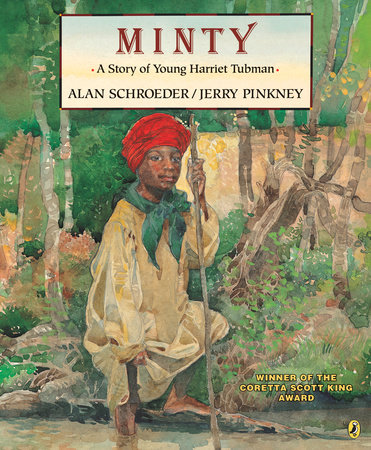
A. BIBLIOGRAPHY Shroeder, Alan. 1996. MINTY: A STORY OF YOUNG HARRIET TUBMAN. Ill. by Jerry Pinkney. New York: Puffin Books. ISBN 0-8037-1888-8. B. PLOT SUMMARY This historical fiction picture book depicts the beginning of a hero’s life. Before she was Harriet Tubman, she was Minty, a young girl, growing up on a plantation with her family. This story depicts the tenacious burgeoning spirit of a woman who would free herself and many others. C. CRITICAL ANALYSIS (INCLUDING CULTURAL MARKERS)
The story Shroeder tells is based on historical fact, but as he explains in a foreword note, the details of the events are fictional. From the first page, he conveys Minty as a sprightly and strong-willed child. She doesn’t readily obey her master, which leads to violent consequences. However, it alludes to the spirit that would one day serve her well.
Through Minty’s parents’ dialogue and others, the reader begins to understand the oppressed mentality of the slaves that had resigned themselves to live in such a way that ardently avoided conflict and retribution. For most, it was simply about survival. The character, Amanda, that works alongside Minty in the fields warns hers about running away. Her attempt had only ended in more abuse. But for whatever reason, Minty had the courage and vision to hope for more. Her father, “Old Ben” prepares and teaches Minty some things that convey his belief and hope for her also.
He includes biblical allusion, as Minty talks to her dilapidated doll. In her retelling of the story of David, she refers to the Goliath character as a “master.” There is hope in this story for her, to defeat her own giants. Religion is a cultural marker for the African American community, but also a double-edged sword. At times, it has offered hope and solace for their suffering, but it has also been used against them to justify the institution of slavery.
The watercolor illustrations are muted in color, but drawn with beautiful detail. One of the only bright colors in the red bandana Minty wears upon her head. This seems intentional, to set Minty apart. Pinkney tries to portray the reality of the clothing and wares of the slaves. Minty is drawn in oversized, dingy clothing. All of the slaves’ clothes seem ragged and mismatched, which seems realistic. The same is true of their environment. In scenes of the slaves’ cabin, the sleeping arrangements are small and constrained, and they all have to share worn and patched blankets. The only housewares are woven baskets or basic cooking pots.
D. AWARDS & REVIEW EXCERPTS ALA Notable Children's Books, 1997
Bulletin of the Center for Children's Books, May 1996
Coretta Scott King Illustrator Award, 1997
Horn Book Magazine starred, September 1996: “Quick action and dialogue create a taut story and clearly depict Minty's strong-willed nature and her desire for freedom. Pinkney's watercolors provide detail and depth in this intriguing and emotional portrait.”
Kirkus Reviews Starred, 1996: “Told in rhythmic prose and colloquial dialogue, the plot has actual events that are small, but it is rich with melodrama, suspense, pathos, and, of course, a powerful vision of freedom. Pinkney's illustrations exhibit, characteristically, his refined draftsmanship; the complicated compositions convey psychological aspects of slavery and make the individual characters even more distinct. This exquisitely crafted book resonates well beyond its few pages.”
Publishers Weekly starred, May 1996
School Library Journal, May 1996
E. CONNECTIONS Other quality children’s books that teach children about the life and heroism of Harriet Tubman are When Harriet met Sojourner by Catherine Clinton, A picture book of Harriet Tubman by David A. Adler, She Persisted: 13 American women that changed the world by Chelsea Clinton.
A. BIBLIOGRAPHY Strange, Lucy. 2018. OUR CASTLE BY THE SEA. New York: Chicken House, an imprint of Scholastic Inc. ISBN 978-1-338-35385-3. B. PLOT SUMMARY Petra Smith’s home was a lighthouse. She was both in love with the sea and terrified of it at the same time. She grew up hearing the terrible tales of shipwrecks and tragedy at sea, but it wasn’t the sea that would threaten her family. Having a German mother and an English father never mattered to Petra, but when World War II broke out, it seemed to matter to everyone else. C. CRITICAL ANALYSIS (INCLUDING CULTURAL MARKERS) Petra’s family is a blend of two different cultures, English and German. Her home is England, but as the war breaks out, her community begins to treat her and her family like outsiders because of her mother’s homeland. Strange walks a fine line by including some of the prejudice that existed during the war for those born in enemy territory without emphasizing too much of the cruelty for her younger readers.
The German influence on Petra’s life seems minimal. The most obvious and significant connection to her mother’s heritage is the language. Petra calls her mother, Mutti, because of the German name for mother, mutter. She can speak and understand German. Her mother sang her German lullabies as a child. Music is another cultural marker in this book. It is a very small one, but specific types of songs are mentioned, especially the mystical songs of the Daughters of Stone.
As an island country, the English culture is strongly tied to the sea. In the book, the legend of the “Daughters of Stone” is a sea myth that also serves as a warning to sailors. Throughout the story, there is a steady flow of references to boats and fishing. Petra and her sister, Magda, participate in a crabbing contest, which leads to a dramatic moment when Petra falls out of the boat into the cold, deep water. Much of the plot action is centered around the sea.
There is a brief mention of cultural food. Scotch eggs are served for a special family breakfast. An iced biscuit is given as a treat.
Strange also included time period markers, such as the use of the generic terms people used for different countrymen during the war. The terms “Jerry” and “Fritz” were used to refer to Germans. There is also certain diction made familiar to the general population because of that particular time in history, such as Dunkirk and Gestapo. D. REVIEW EXCERPTS Booklist starred, March 2019
Horn Book Magazine, May 2019 “ Vivid writing and an intense, intrepid heroine provide its substance and charge, as timid Pet grows to defeat her fears and become a person of strength, courage, and valiant resistance.”
Kirkus Reviews, February 2019
Publishers Weekly starred, February 2019 “Strange seamlessly blends a local legend, of four girls turned into ancient standing stones on the lighthouse's clifftop, with the larger story. A standout historical novel with a memorable protagonist, strongly sketched setting, and a compelling, twisty plot.”
School Library Connection, August 2019
E. CONNECTIONS Middle grade readers may enjoy reading more stories of World War II from the British perspective. For history units on World War II, teachers could also offer reading circles that focus on historical fiction from this time period. Some great titles would be The Little Ships: the heroic rescue at Dunkirk in World War II, by Louise Borden (978-0-689-80827-2), When the Sky Falls, by Phil Earle (978-1-54760-930-7), and The War that Saved my Life, by Kimberly Brubaker Bradley (978-1-43286-585-6).
Pratchett, Terry. 2012. DODGER. New York: HARPER, an imprint of HarperCollins Publishers. ISBN 9780062009494. 2. PLOT SUMMARY Dodger is a tosher, a scavenger of the London underground. He is a sharp young man whose skill and charm were well-known throughout the city. To begin this tale, Dodger comes to the rescue of a young lady in peril, but in order to keep her safe, he must employ all his wits and connections. Known as Simplicity, the young woman’s identity remains somewhat ambiguous, but she attracts the attention of the powerful because of her ties to international relations. Dodger will become her champion, and at the same time, become a champion of London for subduing the infamous, and perhaps misunderstood, Sweeney Todd. 3. CRITICAL ANALYSIS
I learned so much from this little book! It is classified as Fantasy, but I found it to be more Historical Fiction. Pratchett’s use of colloquial language and period references are both entertaining and a little confusing. I had to look up several of the words and phrases to understand the meanings, but I enjoyed learning the new words, like firkytoodle, and historical allusions. One of the most provocative references was the Cross Bones Graveyard of the Winchester Geese. Another subculture of poverty in London, these ‘geese’ were prostitutes that were taxed by the Winchester Bishop and later buried in the pauper’s grave. This is just one of the many examples of heartbreaking, but historical references in the book.
Pratchett does an excellent job of constructing the settings of this book, most interestingly, the mysterious underground world of London’s sewers. Through the eyes and thoughts of Dodger, the reader develops a fondness for this nasty netherworld. Even with the rats and the human waste, the tunnels provide a comfortable background for the lives and work of the toshers. The slums were described in the same way, dangerous, yet hospitable.
There are many colorful characters in this story, some fictional and some historical. Charles Dickens and Henry Mayhew are two of the most historically significant figures that are intertwined in Dodger’s story. Both of whom were real-life advocates for the poor of London. Solomon, a wise, older Jewish friend, provides Dodger with the guidance and caretaking of a father-figure. However, there is a vast network of characters that provide Dodger with the help and assistance he needs to save his damsel in distress.
I believe that Pratchett offers some subtle social commentary on poverty, and I think the desperation it induces is as true today as it was in Victorian London. The story offers an entertaining plot, with fantastical subplots included, but the exceptional quality of this book shines through the captivating dialogue and endearing characterization.
4. AWARDS & REVIEW EXCERPT(S) Booklist starred, October 2012
Horn Book Magazine starred, November 2012: “His original take on the world and his deft way with language make him a wonderful guide through sewers, morgues, theaters, drawing rooms, pea-soup fogs, and barbershops and a story of espionage, romance, action, skullduggery, double-dealing, and heroism.”
Kirkus Reviews, August 2012
Michael L. Printz Honor, 2013
Publishers Weekly starred, August 2012
School Library Journal starred, November 2012: “Pratchett does a bang-up job of recreating Old London for today's audience, complete with pathos, humor, and truly nasty descriptions of the filth, stench, and danger, all narrated in Dodger's unique voice.”
5. CONNECTIONS *This book would be a great addition to a study of Victorian London, along with other books like Constable & Toop by Gareth P Jones, How to Catch a Bogle series by Katherine Jinks, or the Agency book series, by Y.S. Lee.
Sepetys, Ruta. 2016. SALT TO THE SEA. New York: Penguin Books. ISBN 978-0-399-16030-1. 2. PLOT SUMMARY Joana. Florian. Emilia. Alfred. Against the backdrop of World War II, these four tell their stories of struggle, suffering, and loss. Thrown together by dreadful circumstances, a group of ragtag refugees travel together, trying to escape the approaching Russians. However, many of them are also enemies of the Reich. The bonds that form through desperation can be strong and familial. Their fates will converge on the Wilhelm Gustloff, a vessel that promised safety, but delivered doom. 3. CRITICAL ANALYSIS
This is a heart-wrenching book. The suffering that the characters endure is heavy and horrible. Sepetys creates four different narrative perspectives, a German artist, a Lithuanian nurse, a pregnant Polish teenager, and a bullied Nazi soldier.
Three of their stories converge early on, as they are running from impending Russian invasion. Each of them becomes dependent on another for strength or help. The theme of strength of the human spirit is present throughout the story. Death is also another dark theme that weaves through the book from beginning to end, from death of loved ones, death of community and identity, and for some characters, their own deaths.
There are appalling tragedies of war that Sepetys includes that are almost unmanageable for me. This book is not for the faint of heart. She doesn’t include much detail, but rape and infant death are gruesome and heartbreaking. Sepetys includes historical research throughout her story, and I looked in the true story of Nemmersdorf. It made me nauseous. There are points of light and life in the book, but be forewarned. The truth of war is hell. 4. AWARDS & REVIEW EXCERPT(S)
Booklist starred, December 2015: “This haunting gem of a novel begs to be remembered, and in turn, it tries to remember the thousands of real people its fictional characters represent. What it asks of us is that their memories—and their stories—not be abandoned to the sea.”
Horn Book Magazine, January 2016
Kirkus Reviews, November 2015
Library Journal starred, December 2015
Publishers Weekly starred, November 2015
School Library Journal starred, December 2015: “Artfully told and sensitively crafted, Sepetys's exploration of this little-known piece of history will leave readers weeping.”
Voice of Youth Advocates (VOYA), December 2015
5. CONNECTIONS *The sinking of the Wilhelm Gustloff is a little known slice of World War II history. To teach World War II history with a wider lens, books that could offer different perspectives are We are not free by Traci Chee, about young Japanese-Americans sent to internment camps, Night Witches: a novel of World War II by Kathryn Lasky, about the Soviet female pilots, or Eyes of the Emperor by Graham Salisbury, about Japanese Americans training K-9 units to be used in Japan.
**For great middle grade World War II books, The Midnight Zoo by Sonya Hartnett, Code Name Verity and The Enigma Game by Elizabeth Wein and Hero on a Bicycle by Shirley Hughes.
Lee, Mackenzi. 2017. THE GENTLEMAN’S GUIDE TO VICE AND VIRTUE. Coulson, Christian, (Narrator). New York: HarperAudio. 2. PLOT SUMMARY A privileged, young British rascal, Henry Montague, sets out on a tour of the European continent with his best friend and his younger sister. Because of Henry’s indiscretions, the trio find themselves destitute and on the run. Along the way, they will experience new challenges, both internally and externally. Henry will be forced to grow up or lose his most precious confidantes. 3. CRITICAL ANALYSIS The audio recording of this book is a work of art! The narrator, Coulson, does an extraordinary job with all of the different accents and voices. Listening to the story was very enjoyable and entertaining.
The story of The Gentleman’s Guide to Vice and Virtue is somewhat unique. The bisexual perspective of the omniscient first person narrator was a new perspective for me. I am grateful for the glimpse into another’s life experience. Sadly, the 1700s was not a time of acceptance or approval for those outside of the mainstream. All three of Lee’s main characters, Monty, Percy, and Felicity all represent “minority” populations.
Monty is not only condemned, but he is also abused for his sexual identity and behavior. Percy is judged and mistreated for having African heritage and darker skin. Felicity is excluded and oppressed for being female, at a time when women were considered to be the lesser and weaker sex. Although they are marginalized by society, the three find affirmation in each other.
Lee’s descriptive language adds depth and detail to the story. In Chapter 20, Monty says, “Desperation is a strange soil.” This is just one example of her use of figurative language. She also uses biblical allusions, like the story of Lazarus, and symbolism, like the mother’s heart being a panacea.
4. AWARDS & REVIEW EXCERPT(S)
Audie Award nominee for Best Male Narrator 2018
Booklist starred, April 2017
Horn Book Guide, October 2017
Horn Book Magazine, May 2017
Kirkus Reviews starred, March 2017: “The book’s exquisite, bygone meter and vernacular sit comfortably on a contemporary shelf. And the friction of racism, tyrannical entitled politicians, and misguided disapproval of homosexuality also have a relevance rooted in current culture’s xeno- and homophobia. Austen, Wilde, and Indiana Jones converge in this deliciously anachronistic bonbon.”
Publishers Weekly starred, April 2017
School Library Journal starred, March 2017: “This is a witty, romantic, and exceedingly smart look at discovering one's place in the world. VERDICT A stunning powerhouse of a story for every collection.”
Stonewall Honor Book, 2018
5. CONNECTIONS *This YA novel gives a unique historical perspective of a European experience. It could be compared and contrasted with Anatomy: a love story, by Dana Schwartz or I must betray you, by Ruta Sepetys in the same genre.
*In a Humanities class or Sociology class, this book could be a great addition to exploring different sexualities or gender identities. Other YA books that could be helpful in that same vein are Aristotle and Dante discover the secrets of the universe by Benjamin Alire Saenz, The 57 Bus by Dashka Slater, or We deserve monuments by Jas Hammonds.
Lee, Stacey. 2019. THE DOWNSTAIRS GIRL. New York: G. P. PUTNAM’S SONS, an imprint of Penguin Random House, LLC. ISBN 9781524740955. 2. PLOT SUMMARY After being released from her hatter job because of her race, Jo Kuan returns to the Payne’s household as a ladies maid for her childhood adversary. Set in the 1890s in Atlanta, Georgia, Jo’s life with Old Gin had to be modest and inconspicuous. Yet, Jo uses her wit and wisdom to earn a spot in the local newspaper as an ‘Agony Aunt’ or anonymous editorial writer. Her voice will shake things up in their little town, as she challenges some of the customs and opinions of the time. 3. CRITICAL ANALYSIS
Lee tells an important American story, one that is often overlooked or ignored. The unique plight of the Chinese immigrants during the Gilded Age of the Southern United States is unfortunate and distressing. The Asian Americans faced much of the same prejudice and harsh treatment as the African Americans.
Lee does a masterful job of unfolding the intriguing plot of the book. The pacing of the plot development varies, sometimes feeling slower than desired. Nevertheless, the unveiling of the complex relational threads between the characters is satisfying and most entertaining. More than once, characters that seem at odds are discovered to be related. Not only does Lee include ignorant characters that are stereotypical of the historical time, but also characters of compassion who value equality and humanity. There are ones you love and ones you love to hate.
Lee’s use of figurative language is exceptional and effective. In the line, “Monday muscles in like the first rooster in the ring, talons out, ready to draw blood,” on page 149, she uses both personification and simile to convey a strong, specific description of the upcoming day. She also uses metaphor and hyperbole throughout the story to enrich her story.
4. AWARDS & REVIEW EXCERPT(S) Booklist starred, June 2019
Bulletin of the Center for Children's Books starred, July 2019
Kirkus Reviews Starred, June 2019: “She deftly weaves historical details with Jo’s personal story of finding a voice and a place for herself in order to create a single, luminous work. An optimistic, sophisticated portrayal of one facet of Chinese American—and simply American—history.”
Publishers Weekly starred, June 2019
School Library Journal starred, June 2019: “Though society may try to push aside those it sees as different, Jo demonstrates that everyone has a place and a story to be told.”
Teacher Librarian, October 2019
Voice of Youth Advocates (VOYA), June 2019
5. CONNECTIONS *This historical fiction book would be a great addition to a study of the Chinese American experience. Other books that would also be great extensions for learning are Last Night at the Telegraph Club by Malinda Lo, American born Chinese by Gene Luen Yang, or The secret battle of Evan Pao by Wendy Wan Long Shang.
Palacio, R.J. 2019. WHITE BIRD. New York: Alfred A. Knopf. ISBN 9780525645535. 2. PLOT SUMMARY Julian has been recently expelled from school because of his bullying behavior toward another student (our beloved Auggie, from Wonder.) At his new school, he is assigned to research someone and write an essay about his/her life. He has chosen his grandmere, his beloved grandmother, Sara. She tells him the harrowing story of her life during World War II, as a Jewish French citizen. Her story is filled with both love and hate. As the Nazis invade her town, she is forced to separate from her family, and finds herself at the mercy of a kind classmate. The bravery, compassion, and generosity of the people in Sara’s story will inspire her grandson, as well as the reader. Palacio connects the past to the present and once again, petitions for our humanity. 3. CRITICAL ANALYSIS This graphic novel is very well done! Palacio is so talented, to be both the writer and illustrator of this work. Kevin Czap is the artist that “inked” the story, which I recently learned is a crucial role in graphics. Czap created the shades and shadows of the drawings.
The color choices create the tone of the story, and in this case, the muted colors of the flashback story are different from the brighter colors of the current day story. The narrator, Sara Blum, describes her younger life as a fairytale, and the color choices match that description- soft, happy colors. Then the shades associated with the evil of the Nazis and conspirators are darker and more shadowy.
I loved that this story was told in the form of a graphic novel. The pictures added so much to the story. The emotions of this book are strong, and the details of the characters’ body language and facial expressions added to the depth and complexity of the emotion. Also, the symbolism was augmented by the visual aspect. For example, the yellow scarf that the sacrificial school teacher gives to Sara, as a symbol of hope and strength. Sara wears it throughout her time in hiding, but then she passes it along to Madame Beaumier, who must continue to face life without her son.
There is a strong social-emotional lesson here. A connection is quickly made between bullying and oppression. Bullying is a term that one may view as banal or innocuous, but abuse and cruelty get our attention much quicker. They are one in the same, and Palacio shows her reader both the evidence and consequence.
4. AWARDS & REVIEW EXCERPT(S)
Kirkus Reviews starred, July 2019, “ Although the book is being marketed as middle-grade, the complexities of the Holocaust in Vichy France, the growing relationship between Sara and Julien, Julien’s fate, and the mutual mistrust among neighbors will be most readily appreciated by Wonder’s older graduates. A must-read graphic novel that is both heart-rending and beautifully hopeful.”
Publishers Weekly, July 2019
School Library Journal, September 2019, “Moments set in the present featuring Julian and Grandmère frame the tale and draw parallels to family separation at the U.S. border, offering a powerful conclusion.”
Sydney Taylor Book Award, 2020
5. CONNECTIONS *The topic of bullying needs to be addressed throughout every stage of schooling. This book would be a poignant addition to a SEL unit on bullying, along with Fish in a Tree, by Lynda Mullaly Hunt, Restart by Gordon Korman, or A First Time for Everything by Dan Santat. *White Bird would also be a great complementary piece of a Holocaust study, alongside other middle grade books like Number the Stars by Lois Lowry, Resistance by Jennifer A. Nielsen, or Village of Scoundrels by Margi Preus. There are so many more!